When the Nazi concentration camps were liberated by the Allies, it was a time of great jubilation for the tens of thousands of people incarcerated in them. But an often forgotten fact of this time is that prisoners who happened to be wearing the pink triangle (the Nazis’ way of marking and identifying homosexuals) were forced to serve out the rest of their sentence. This was due to a part of German law simply known as “Paragraph 175” which criminalized homosexuality. The law wasn’t repealed until 1969.
This should be required learning, internationally.
You need to know this. You need to remember this. This is not something to swept under the carpet nor be forgotten.
Never. Too many have died for the way they have loved. That needs stop now.
Make it stop?
I did a report on this in my World History class my sophomore year of high school. It was incredibly unsettling.
My teacher shown the class this. Mostly everyone in the class felt uncomfortable.
I have reblogged this in the past, but it is so ironic that it comes across my dash right now. I a currently working as a docent at my city’s Holocaust Education Center (( I say currently because I’ve also done research and translation for them )) and out current exhibit is one on loan from the United States Holocaust Memorial Museum ((USHMM)). This is a little known historical fact that Paragraph 175 was not repealed after the war and those convicted under Nazi laws as a danger to society because they were gay were not released because they had be convicted in a court of law. There was no liberation or justice for them as they weren’t considered criminals, or even victims for that matter. They were criminals who remained persecuted and ostracized and kept on the fringes of society for decades after the war had been won. Paragraph175 wasn’t actually repealed until 1994. And it was only in May 2002, that the German parliament completed legislation to pardon all homosexuals convicted under Paragraph175 during the Nazi era. History has forgotten about these men and women — please educate yourselves so this does not happen again. Remember this history. Remember them.
@mindlesshumor ok how the fuck did I miss this when I’ve studied The Holocaust like nobody’s business??? wtf
Because the history we have left regarding it is literally the contents of this first hand account.
It is a thin little book.
When I first opened it, I wondered why it was so thin.
Why there wasn’t other books like it.
Other first hand accounts.
By the time I finished it, I didn’t wonder anymore.
Bent by Martin Sherman (fiction; however, it’s often credited with bringing attention to gay Holocaust victims for the first time since the war ended)
This is one of the memorial sculptures in Dachau. It was erected in the early 60s and is missing the pink triangles. Because in the early 60s, homosexuality was still a crime in most of the world. Our tour guide explained why the pink triangles have not been added later – if they were, then folks would assume that they had always been there. This way people ask “why aren’t there pink triangles?” and somebody can explain why – because in some ways, the rest of the world was as bass-ackwards as Nazi Germany.
can i just say i was literately in a genocide and holocaust class and i didnt even learn this
let me share a memory with y’all. it’s from i guess 1978 or thereabouts. it’s high summer. i don’t remember where my mom was driving me, in our avocado green chevette, i just know there was a traffic jam that turned 35w northbound into a parking lot from horizon to horizon.
picture it – wait, you don’t have to use your imagination, this happened all the damn time back then.
every one of those damn cars was burning leaded gasoline. there were no emissions regulations. there were no safety regulations. there were just thousands and thousands of detroit steel shoeboxes belching visible smoke as they idled, engines loud and hot, here and there a radiator giving up in the heat, a cloud of burning oil rising.
i, a smeet of five or six, was choking on toxic smog.
i reckon it was about a half hour into the traffic jam that i first threw up. i remember a blinding headache, i remember being confused, i remember dry heaving with my arms and head hanging out the window, the green metal of the car burning my hands and my chin. i don’t remember passing out, but i’m told i lost consciousness before mom was able to get to an off-ramp, because there were no emergency lanes on the highways back then.
i lived. and life went on. what were we going to do, complain? if i’d died, the cause of death probably would’ve been recorded as heatstroke, not carbon monoxide poisoning.
i know i’m probably preaching to the choir here on tumblr. but i really wish i could tell that story to the people who think deregulation is no big deal. i wish they’d put themselves in my mom’s shoes.
or even just look at some old pictures, then look out the window.
ever notice how cityscapes used to have that orange tint and hazy aura? yeah, that’s poison gas.
remember how the mississippi river used to be a stinking soup of baby-shit yellow sludge covered with disturbingly stiff rafts of light orange foam?
i can’t even find pictures of the sludge and foam, i guess they didn’t end up on the internet. the smell was indescribable. that oily shimmer. the reek of dead things. people didn’t boat on the river for pleasure; it smelled too bad, it was too ugly, and you could get super super sick if you touched the water.
and now look at it.
i still wouldn’t want to drink it, but if i fell in i wouldn’t bolt for the shower in a panic, you know?
if the thieving billionaires get their way, we can kiss those sailboats goodbye, and learn the smell of toxic foam once more. the ultra-rich won’t even feel the extra money, they’ve already got more than they could ever touch, they just stash it in offshore accounts to rot, but the rest of us will return to a time of neverending nausea and weird cancers. a time when every elementary school class had at least one kind who’d been born with no fingers or their heart outside their body, and this was just… the way things were.
i’m sorry. i didn’t mean to longpost. it’s just. god. y’all have no idea how CLEAN everything is now, compared to when i was a kid. and these rich old men are counting on that, on people not knowing or not remembering how bad it was before regulation, not realizing how much we need these protections until it’s too late.
I enforce federal worker health and safety and pollution regulations.
When I was learning my trade, when my classmates and I were having a chuckle over the “well duh” level of specificity written into the Code of Federal Regulations (try “no hazardous material shall be stored in crew berthing” on for size), I will never forget the silence that followed when our instructor spoke these words:
“Your regulations are written in blood.”
These regulations were not written on a whim.
They were written because someone thought they could cut costs by storing however many more pounds of a radioactive, toxic, carcinogenic, or whatever else material in the same rooms where the human beings they paid to transport those materials slept, and then did that, because no one was telling them not to.
They were written because people died. Horrifically. Because unregulated capitalism values profit over human life and suffering.
Can I say it again, for those not paying attention?
Unregulated capitalism values profit over human life and suffering.
I literally can’t get myself to sit through movies that don’t have women. I’m like where the fuck are the women? Why are there so many men? This is boring as fuck goodbye
Even if it’s historically accurate?
as everyone knows, women were invented in 1990
All the notes of “women weren’t on old time battlefields” are wrong. There were more prostitutes and merchant women than there were soldiers in most every encampment. They followed the armies, marching alongside them, and notably ran the camps.
Many more women dressed as men to fight.
Long before female nurses were officially considered to be a part of the military, they were already on the battlefield. They merely didn’t get written into official reports because they were “invisible women”, “not supposed to be there”. Usually they would be local women running a makeshift care center out of their homes.
Movies involving ancient societies? Guess how many had female fighters?
Spies? Mostly female. Yeah, only the men were caught, usually (because nobody suspected the servant woman), but historians believe most cases had more women spies than men. Most cases meaning across time and continents.
Giving me a movie on samurai? Women were trained as well to avoid being captured and raped, and often fought just as hard as men. One woman notably survived multiple battles, and became a hero alongside her sisters after taking out 7 men before dying in her last fight (usually in sword fighting you’d be lucky to take out 2 enemy soldiers. 7 is fucking insane, but because she was a woman it was shoved under the records how the lord managed to survive).
Women have ALWAYS been on battlefields. Women have an intense history in driving victories and losses alike. They were supply runners, fighters, spies, assassins, prostitutes (look up how prostitutes essentially ran the western world, or even the social status of harem members. They literally fucking ruled), even underground activists.
The only time there weren’t many women were with cowboys. Actual western cowboys tended to be both POC and gay. In fact, any time women didn’t have a near equal or greater presence, there was a LOT of gay men.
History: either 80% female or 100% gay. And it’s 95% POC.
Actually, the Wild West (while not really associated with warriors and battlefields) would be one of the historical settings with the best recorded history of women (specifically prostitutes) running the place:
Vikings had dirty matted ass hair because ancient Europeans were a filthy people who would shit in their drinking water and wonder why they got sick
You’re both wrong.
Vikings bathed like all the damn time. It was one of the reasons for a long time you had people from the rest of Europe seeing them as untrustworthy weirdos. They carried combs on their belts because they put a lot of stock in having orderly and often elaborately braided hair. Sometimes they’d pack the braids with mud to hold them in place in battles (which their opponents, like the COMPLETELY non-bathing Romans) would mistake for dreads, but in peaceful situations they’d immediately clean it out again.
The Vikings didn’t have dreads, but they were also a pretty clean group of people until they were forcibly assimilated into the rest of medieval Europe.
Thank you for laying down some history truth!
Vikings bathed once a week, and that made all of Europe think that they were stuck-up prudes.
They also thought they were nuts for *gasp* WEARING AND WASHING UNDERWEAR.
The vikings bathed so much they were accused of trying to seduce woman solely based on how clean they were:
speaking as a Jew, i’m extra-super dubious of all that stuff that talks about cartoon witches being an antisemitic stereotype. I can get where the thing with the nose is coming from, but the claims about the hats are based on flimsy claims that require a lot of mental reaching. The hats that Jews were forced to wear were not a universal thing, and I’ve yet to see any evidence that they were part of the cultural consciousness by the time the image of the pointy-hatted witch became common.
The biggest points against the hat hypothesis:
Wrong time period: witch hats as we know them seem to have only started appearing in art around the 17th-18th century; in the period when the Judenhut was well-established, witches in art just wore whatever was common for women of the region.
Wrong region: the pointed witch hat originated in English art, as far as i’ve seen. Antisemitic laws in England mandated badges, not headwear.
Wrong gender: Jewish hats were mandated for men, not women—illustrations of witches with pointed hats very rarely included male witches, until fairly recently.
Wrong shape: there are many styles of mandated Jewish hat throughout history, but few of them are even a near match for the very specific look of the Witch hat.
You know what kind of hat does closely fit?
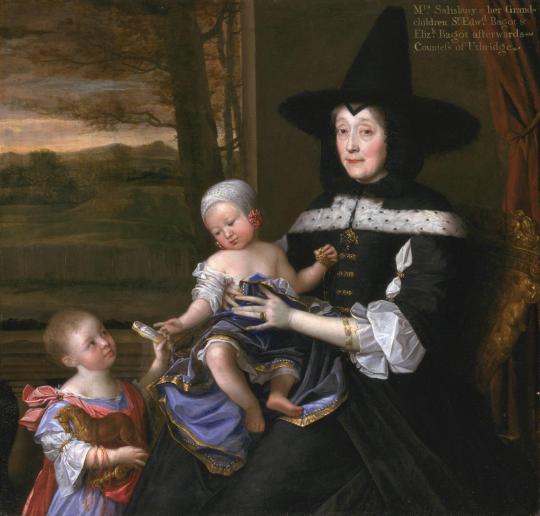
The hat in this painting (“Portrait of Mrs Salesbury with her Grandchildren Edward and Elizabeth Bagot” by J.M. Wright; circa 1675) was “a type worn by affluent women throughout Britain at this date”. Look at that hat. Any modern viewer looking at this painting might think it was supposed to be a character created by J.K. Rowling.
It’s a match in design, gender, region, and most importantly, time period: by the time that pointed witch hats started to appear in artwork in England and English colonies, this style of hat would have been associated in the cultural consciousness with elderly women, especially those who were clinging to decades-old fashions.
The easy, simple answer to where the witch hat came from: it’s exactly what a woman with all the stereotypical qualities of a witch would have worn in the first place, in the time and place the trope originated.
Old-fashioned but not by several centuries, severe and somber, and popular with a class of women that people would have spread nasty rumors about in the first place (somany accusations of witchcraft were directed specifically at women who were independently well-off, whether out of simple envy or else scheming).
Seemed like about time to bring this back up.
Another very obvious and often explicitly stated basis for the CLOTHING of the cartoon witch is Puritan costume from the 18th century… seeing as Puritans were famous for their witch trials.
The green skin, curly hair, big nose, warts etc are all definitely at least racialized things. Though big nose and warts are associated with age the combined picture is pretty much just a racial caricature.
Important input on the witchy costume debate, from a Jewish person who’s clearly done a bit of homework on the origins of pointy hats and green makeup. (And who also seems to be a pretty cool person into the bargain.)
I’ve reblogged this before, but it’s got new info, which is great
I’d also argue that, though certain aspects of the stereotypical witch align with antisemitic tropes, it’s far more likely that witches’ stereotypical looks actually emerged by being the polar opposite of what the beautiful, and therefore ideal, 17th century woman looked like. This was to emphasize that a witch was the OPPOSITE of an ideal woman, and she could thus be placed in opposition to the beautiful, ideal heroine.
Where beauty (according to 17th century standards) was young, witches were old. Where beauty had fine, delicate features, witches had exaggerated, rough features. Where beauty was relatively unmarred (a rarity in pre-vaccination days), witches had moles and other marks. Where beauty had silky blonde hair (a treasured prize in Renaissance times, to the point that women falsely lightened their hair or wore wigs), witches had rough black hair.
As I said, some of these line up with antisemitic tropes. However, I’d argue that associating Jews with these tropes was a result of already-established patriarchal beauty tropes that had been ingrained in northern Europe for centuries. The fact that the stereotypical Jewish woman happened to defy the beauty ideals of northern Europe was used as an excuse to further oppress Jewish people, not the other way around.
In other words, I’d guess that it went like this:
“Ugliness/evil looks like this” -> “Some Jewish women (who we hate) look like this” -> “here’s proof that Jewish women are ugly and evil”
Rather than:
“Jewish women look like this” -> “we hate Jewish people” -> “Ugliness and evil looks like this”
Of course, once both tropes (ugly witches, ugly Jews) were established, I imagine that they fed into one another, but I’m dubious of the claim that the source of the ugly witch was the Jewish woman, especially since northern European ideas of beauty and fears of malevolent witches seem to go back further than northern European stereotypes of the ugly Jewish woman.
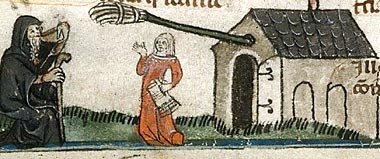
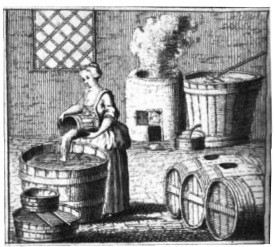
Augh, and COMPLETELY forgot to talk about this, but the stereotypical witch outfit? It comes from traditional English brewsters/alewives, aka, female beer-brewers.
Who used brooms mounted above the door as a way to signal their trade to passerby:
And who made their trade making strange concoctions in cauldrons:
And who happened to wear hats just like this:
Brewsters/alewives used to have a monopoly on beer-making. They handed down brewing secrets from mother to daughter and basically controlled the alcohol market. And men weren’t terribly keen on that – they wanted in on this immensely lucrative, influential field. There were some male brewsters, but the trade was overwhelmingly female, to the point that even male brewsters were still called brewsters – a female noun.
So what do men do when they want to push women out of a trade? They demonise them.
Suddenly the broom isn’t just a business sign, it’s a tool for going to meet the devil. The cauldron isn’t just a tool, it’s a place to create evil. The hat isn’t just a trade uniform, it’s a mark of malevolent intent and arcane knowledge.
Coincidentally, many women who became brewsters/alewives became independently wealthy and quite powerful locally. They didn’t need to marry and could provide for their entire households with their trade. They could grow old without marrying, or they could stay unmarried after their first husband dies rather than remarrying. They could also pull strings and influence things in their favour, making local politics ‘mysteriously’ go their way.
And so the stereotype of the ugly spinster brewster-witch is born.
And, as I’ve said above, ugly women look a certain way: harsh, marred features, dark, tangled hair, and above all, old.
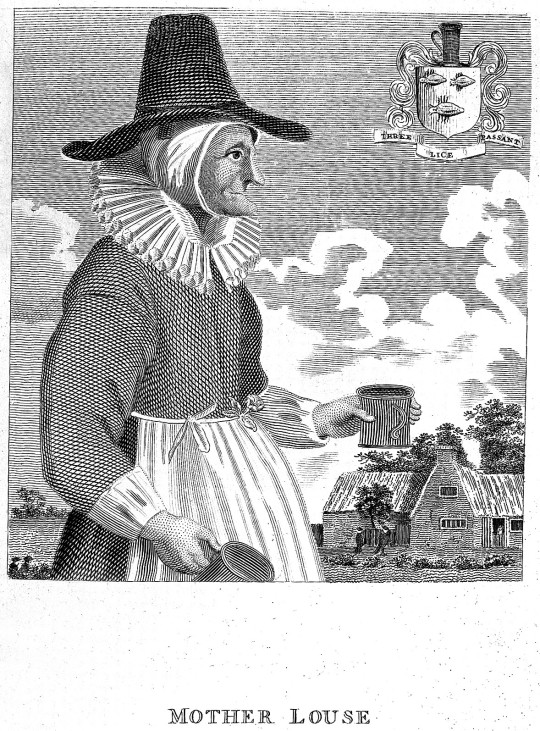
Note old Mother Louse up there. She was a well-respected brewster in her town, with plenty of influence, but here she is already being portrayed with stereotypical witch features: a big, hooked nose, and a pointy chin, hollow eyes, sharp cheekbones (not a good thing in premordern times – beauties had rounder faces, as sharp cheekbones were a sign of hunger or oldness). Mother Louse isn’t being portrayed as Jewish, but as an elderly, ugly spinster, who engages in the lucrative, powerful – but suspect – business of brewing.
Know who else this happened to? Midwives. Another female trade, passed down from woman to woman, dealing in business secrets from which men were barred – and this in regard to the most mysterious power of all: the power to bring life into the world. And midwives do pretty well for themselves, too: plenty of families are willing to pay a bundle to make sure their babies are delivered safe and sound in a world with high infant mortality. Just like male physicians, midwives knew how to create tinctures and mix herbs, but now, once again, rudimentary chemistry and herb-lore become demonised when women are the ones doing it. Now, if your baby is born sick, deformed, or dead, it’s clearly the spinster midwife’s doing, full of spite because she has no children of her own.
Anyway, there’s your witch history for the day. The hooked nose and black hair are already something of a stretch, but the claim that the typical witch hat is somehow linked to anti-semitism and not brewsters is totally ahistorical.
Chinese emperor Ai of Han, fell in love with a minor official, a man named Dong Xian, and bestowed upon him great political power and a magnificent palace. Legend has it that one day while the two men were sleeping in the same bed, the emperor was roused from his sleep by pressing business. Dong Xian had fallen asleep across the emperor’s robe, but rather than awaken his peaceful lover, the Emperor cut his robe free at the sleeve. Thus “the passion of the cut sleeve” became a euphemism for same-sex love in China. — R.G.L.
get you a dude who will fuck up his own clothing for you
NO OKAY THIS IS REALLY COOL SO SHUT UP AND LISTEN KIDS. Ancient China was super chill about homosexuality okay. Like we have gay emperors and feudal lords, lesbian princesses who were girlfriends with their serving maids, gay ass poets who wrote lots of poems about that one courtesan who played the guzheng so well.
In fact homosexuality was so okay that in Shiji, which is basically the Bible of Ancient Chinese history, there is an entire section dedicated to the gay lovers of emperors. What’s the best part? All the laws and criticism about homosexuality in Ancient China were all about shit like prostitution and rape. These laws were outlawing homosexual stuff were all very specific.
For example, there were laws banning male prostitution, but no laws against homosexuality. These laws were passed to stop the spread of prostitution and laws targeting prostitution in general were pretty common in Chinese history. There were also really strict laws about male rape. Rape was punishable by death, regardless of the gender of the victim. Rape a girl, you die. Rape a guy, you die. Have sex with a minor, you die regardless of whether it was consensual. The lightest sentence you could get was slavery where you were bound to the army.
Also scholars wrote essays criticising the boyfriends of emperors, saying that they distracted the emperor from work blah blah blah but THEY ALSO DID THE SAME FOR THE CONCUBINES. That’s right – the issue wasn’t homosexuality but rather the hormones of the emperor. They didn’t care about the gender of the emperor’s favourite lover but rather the fact that the emperor was too horny to get shit done.
“But WAIT, Modern China is a hardass about homosexuality!!!! How do you explain that!”
Yes. That. That’s because of the late Qing years where Western influences entered the country and brought their gross ass homophobic attitudes with them. And the Qing government was so anxious to seem modern and be seen as equals to their Western counterparts. So they adopted Western ways and discarded their previous attitudes about homosexuality. Hence you have Modern China.
So the next time someone tries to tell you that being LGBT is wrong because it goes against traditional Chinese values, tell them to go fuck themselves with 3000 years of Chinese queerness.
I think a detail that a lot of fans miss about Cuphead is exactly why King Dice is “the Devil’s right-hand man”. From a modern perspective, he doesn’t seem to be doing anything particularly bad – but attitudes toward gambling in America were very different in the era that Cuphead is calling back to.
While the prohibition of alcohol in the 1920s is well known, it’s less often remarked upon that the moral panic of the early 20th Century also targeted gambling. In many states, most forms of gambling were straight-up illegal, and the penalty for violating those laws could carry the kind of prison sentences usually reserved for trafficking in hard drugs. Casinos were less respectable than brothels, and anyone who gambled habitually was assumed as a matter of course to be involved in organised crime, and probably some sort of weird sex pervert on top of it.
That attitudes are so different today is the result of a decades-long public relations campaign to rehabilitate gambling’s image. The modern notion of the casino as a fun holiday destination is so far removed from the previous century’s squalid vice dens, we might as well be living on a different planet!




 Mathee's Blog