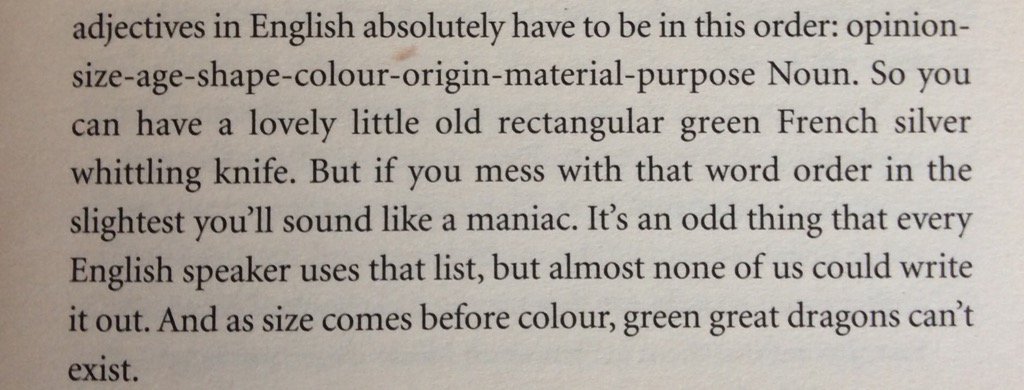
things english speakers know, but don’t know we know.
WOAH WHAT?
That is profound. I noticed this by accident when asked about adjectives by a Japanese student. She translated something from Japanese like “Brown big cat” and I corrected her. When she asked me why, I bluescreened.
What the fuck, English isn’t even my first language and yet I picked up on that. How the fuck. What the fuck.
Reasoning: It Just Sounds Right
Oooh, don’t like that. Nope, I do not even like that a little bit. That’s parting the veil and looking at some forbidden fucking knowledge there.
How did I even learn this language wtf
I had to read “brown big cat” like three times before my brain stopped interpreting it as “big brown cat”
I’m kinda reading “brown big cat” as “brown (big cat)”, that is, a “big cat” – like a tiger or lion or other felid of similar size – that happens to be brown. “Big brown cat”, on the other hand, sounds more like a brown cat that’s just a bit bigger than a regular housecat – like a bobcat or a maine coon cat or something like that.
yeah, a brown big cat is almost certainly a puma. a big brown cat is probably a maine coon.
yeah, if you put the adjectives out of order you wind up implying a compound noun, which is presumably why we have this rule; we stripped out so much inflection over the centuries word order now dictates a huge amount of our grammar
Just looked up why we do this and one of the first lines in this article is, “Adjectives are where the elves of language both cheat and illumine reality.” so I know it’s a good article.
“It’s possible that these elements of universal grammar clarify our thought in some way,” says Barbara Partee, a professor emeritus of linguistics and philosophy at the University of Massachusetts-Amherst. Yet when the human race tacitly decided that shape words go before color words go before origin words, it left no record of its rationale.
One theory is that the more specific term always falls closer to the noun. But that doesn’t explain everything in adjective order.
Another theory is that as you get closer to the noun, you encounter adjectives that denote more innate properties. In general, nouns pick out the type of thing we’re talking about, and adjectives describe it,” Partee told me. She observes that the modifiers most likely to sit right next to nouns are the ones most inclined to serve as nouns in different contexts: Rubber duck. Stone wall.
Rules are made to be broken. Switching up the order of adjectives allows you to redistribute emphasis. (If you wish to buy the black small purse, not the gray one, for instance, you can communicate your priorities by placing color before size).
Scrambling the order of adjectives also helps authors achieve a sense of spontaneity, of improvising as they go. Wolfe discovers such a rhythm, a feeling-his-way quality, when he discusses his childhood recollection of “brown tired autumn earth” and a “flat moist plug of apple tobacco.”
Brain scans have discovered that your brain has to work harder to read adjectives in the “wrong” order.
TL;DR: No one knows why we do this adjective thing but it’s pretty hardwired in.
aliens: because theres people who think that english is the only language they need to speak
me: thats fair i understand
For some reason I find this all the more amusing because it’s written in English
moi: pourquoi vous détruisez le monde!!! l’extraterrestre: parce que il y a des gens qui pensent que l’anglais est le seule langue pour parler moi: ah ça c’est bien
ich: warum zerstört ihr die erde!!!
aliens: weil es leute gibt die glauben dass englisch die einzige sprache ist die sie sprechen müssen
ich: das ist fair ich verstehe
ég: af hverju eyðileggið þið jörðina!!! aliens: af því að það er fólk sem finnst að enska sé sú eina tungumál sem þau þurfa að tala ég: oh, það er vit í þessu. ég skil.
ik: waarom vernietig je de aarde!!!
aliens: omdat er mensen zijn die denken dat engels de enige taal is die ze hoeven te spreken
ik: oh zo, ik snap het
minä: miks te tuhootte maapalloo?
alienit: koska tääl on ihmisiä joitten mielestä englanti on ainoo kieli jota niitten täytyy puhua
minä: toi on reilua, ymmärrän
私: どうして地球を滅ぼしているんですか?
宇宙人: 英語しか喋る必要がないと思う人がいるからです
私: なるほど、わかりました
me: Wosück maakt ji de Welt twei!!!
aliens: wieldat dat Lüüd gifft, de dinkt dat Engelsch de allenige Spraak weer, de een snacken mütt
me: jo, daar seggst wat. Nu versta ik’t
aniga: dhulka maxaad u burburinaya !!!
shisheeyaha: dadka intiisa badani u malaynayaan in Ingiriisidu tahay afka oo kaliya ay u baahan yihiin inay la hadlaan
aniga: waxaan fahamsanahay. waa wax cadaalad
我:你们为什么在毁灭地球?!!
外星人:因为有人以为他们只会英语就可以了
我:懂了,说得有道理
ako: bakit niyo sinisira ang mundo!!!
taga-ibang planeta: kasi merong mga taong akala nila Ingles lang ang kailangan nilang matutunang lenggwahe
ako: ah, sige naiintindihan ko
Aku : kenapa kau hancurkan bumi!!! Alien : karena masih banyak orang berpikir hanya bahasa inggris satu-satunya bahasa yang terpenting Aku : oh, oke lah..
tôi: tại sao các người hủy diệt trái đất!!!
người ngoài hành tinh: bởi vì có người nghĩ rằng tiếng Anh là thứ tiếng duy nhất mà họ cần biết
tôi: ồ thế thì tôi hiểu
Eu: Por que vocês estão destruindo a Terra?! Aliens: Porque há pessoas que pensam que o inglês é a única língua que eles precisam falar. Eu: Isso é justo, eu entendo.
jag: varför förintar ni jorden!!!
utomjordingar: för det finns folk som tror att engelska är det ända språket de behöver kunna
jag: rimligt, jag förstår
Já: Proč ničíte Zemi?
Mimozemšťani: Protože tu jsou lidé, kteří si myslí, že angličtina je jediný jazyk, který potřebují znát
Já: To je fér, to chápu.
ja: dlaczego niszczycie Ziemię?
kosmici: ponieważ są ludzie, którzy myślą, że angielski to jedyny język, którego potrzebuję
ja: rozumiem, w porządku
io: perchè state distruggendo la terra!!!
alieni: perchè ci sono delle persone che credono che l’inglese sia l’unica lingua di cui hanno bisogno
io: capisco, mi sembra giusto
Yo: porqué estás destruyendo la tierra!?!?
Extraterrestre: porque hay personas quienes creen que inglés es la única lengua que se tiene que hablar.
Yo: te entiendo, es justo.
Я: Почему вы уничтожаете Землю?!?! Инопланетяне: Потому что есть люди, которые считают, что им нужно говорить только по-английски. Я: А, ну понятно, тогда ладно!
A modern Rosetta stone.
Mig: Hvorfor ødelægger I jorden!!!
Rumvæsner: Fordi der er folk som tror engelsk er det eneste sprog de behøver at tale
Gaelic hasnt been lost. It’s never died or been brought back. There’s an unbroken line of native speakers going back to the beginning of the language. That doesn’t seem like a ‘lost’ language to me. Furthermore I’m not sure what ‘artificial life-support’ means in this context. Gaelic is given funding for schools because there’s still native speakers of the language. It’s no more artificial than money being given to schools for English language lessons.
If anything is ‘artificial’ its the imposition of a foreign language
(English) into a Gaelic majority zone and native speakers having to
fight for decades to be able to be taught in their own language. Native speakers being forced to learn English to exist within their own regions because a central government would not allow services to be given in a people’s own language.
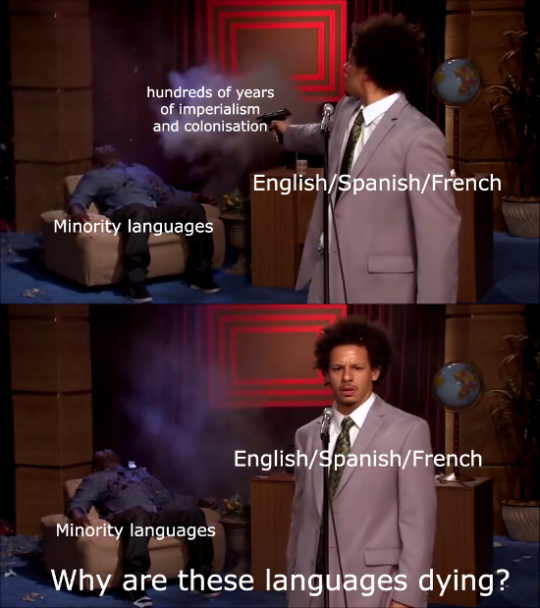
But then the clock only goes back so far with people who wish that minority languages would just die. There’s nothing artificial about shooting someone but suddenly it becomes an ‘artificial’ act to maybe phone an ambulance?
“There’s nothing artificial about shooting someone but suddenly it becomes an ‘artificial’ act to maybe phone an ambulance?” — THIS RIGHT HERE
Also just gonna point out here:
In the UK, the languages Gaelige, Gaelic, Cymraeg and Kernewek (that’s Irish, Scottish, Welsh and Cornish respectively) didn’t just “die out.” There was a concerted effort by the English to kill them off.
For example, in Wales, if a child was heard speaking Welsh in a classroom, they’d be given a “Welsh Not”, a wooden plaque engraved with “WN” to hang around their neck. They’d pass it onto the next child heard speaking Welsh, and whoever had the Welsh Not at the end of the day was punished – usually with a beating.
Kernewek was revived after a long hard struggle by the Cornish folk, and is now being taught again, but a lot about it has been lost because everyone who grew up speaking it has died.
And languages are never revived “just because.” The language of a place can offer so much insight into its history, so if you’re content to let a language die then you’re content to let history die.
People talk about “dead” languages as if they dwindle away gradually, naturally coming to an end and evolving into something else, but that’s rarely the case. Languages like Cymraeg and Gaelige and especially Kernewek didn’t have the chance to die with dignity, they were literally beaten out of my parents and grandparents.
Is it any wonder every other country hate the English? We invade their country, steal their history, claim pieces of their history as ours or flat out re-write it, and kill every part of their culture that we can.
It’s a miracle that any of the Celtic languages survived, so even if you don’t see the point in keeping them alive, the actual natives of each country we’ve fucked over are clinging onto what heritage they have left through the only thing they can: their language.
Hey OP, póg mo thóin!
*snerk* xD
I would like to point all of these “just let it die” assholes directly at Hebrew.
The language was effectively dead. It had been murdered and forced-assimilated away.
But there was this dude named Ben Yehuda.
And he said “no.”
“The language of my people for four thousand years or more,” he said, “should not stop existing because of a bunch of assholes.” (Okay, this is a dramatic retelling. He probably didn’t actually say assholes.)
So he started an official movement to recreate Hebrew as closely as possible to how it had been spoken about a thousand years prior.
Today, ancient Hebrew is spoken by millions of Jews around the world weekly in our prayers and Torah readings, and modern Hebrew is the official language of eight and a half million people–many of them having been born speaking it as a first language. Many people in the first group also speak at least some modern Hebrew–and it’s possible you do, too! A lot of loan words from Hebrew and Yiddish have made their way into English (like klutz, mensch, and kibitz).
That’s hardly “on life support.” Hebrew is growing, living, and thriving because of the Enlightenment efforts of the 1800s. The same COULD be done for languages like Welsh, Navajo, and Basque if the larger powers that be said “this is important” rather than forcing a giant bastion of culture–the language in which a people lived, loved, thought, told stories, and explained their world–to die.
there is a distinct difference between language that has died because it stopped meeting the needs of the people using it and language that has been deliberately killed by oppressors
I remember reading a linguist’s thoughts on this a while back. They noted that languages are not only an important cultural heritage, but also an important historical artifact that offers a look into the unique perspective of a culture. The things that we name and how we name them reflect our values and priorities. For example, Inuktitut is said to have several different words for snow that categorize them by various metrics. This reflects a need for communication regarding what the snow was like, which naturally would be important to a people who deal with snow on a near constant basis. There are nine different ways to say “you’re welcome” in Native Hawaiian, each responding to a different level of gratitude. You don’t respond the same way to “thanks for giving me a donut” as you do to “thanks for saving my life.” This reflects a culture of accountability and honor.
The study and preservation of indigenous languages worldwide is vital to the enrichment of our global culture. You don’t have to be fluent in multiple languages to be able to understand the perspective that is offered by nurturing this tradition. Our ability to communicate is one of our greatest gifts – what a waste it would be to throw that away simply because providing institutions of cultural heritage is too inconvenient.
Honestly, as a German I can not quite understand the obsession of the English speaking world with the question whether a word exists or not. If you have to express something for which there is no word, you have to make a new one, preferably by combining well-known words, and in the very same moment it starts to exist. Agree?
Deutsche Freunde, could you please create for me a word for the extreme depression I feel when I bend down to pick up a piece of litter and discover two more pieces of litter?
um = around
die Welt = world
die Umwelt = environment
ver = prefix to indicate something difficult or negative, a change that leads to deterioration or even destruction that is difficult to reverse or to undo, or a strong negative change of the mental state of a person
der Müll = garbage, trash, rubbish, litter
-ung = -ing
die Vermüllung = littering
ver- = see before
zweifeln = to doubt
-ung = see before
die Verzweiflung = despair, exasperation, desperation
die Umweltvermüllungsverzweiflung = …
This is a german compound on the spot master class and I am LIVING
Don’t leave out any hard of hearing children who come to your door this Halloween, take a minute out of your day to learn a few seasonal asl signs! These are two different variations of “Happy Halloween” Click here for my source.
halloween is for everyone!!!!!!
this is honestly the cutest thing ever 10/10 will do this year💗💗
Hey all! This poem is part of my chapbook Miss Translated, which I produced in a limited run as Town Hall Seattle’s Spring 2017 artist-in-residence. The main conceit behind this work is that to accurately portray my relationship with Spanish, I have to explore the pain and ambiguity of not speaking the language of my grandparents and ancestors. As a result, these poems are bilingual … sort of. Each one is translated into English incorrectly.
The poems I produced have secrets, horrific twists, emotional rants, and confessions hiding in the Spanish. It’s my hope that people can appreciate them regardless of their level of Spanish proficiency.
oh shit. my spanish is pretty shaky, but i’m pretty sure “te perdono” is “i forgive you.” wow understanding just that much is pretty chilling.
and something about…blood? and transformation? oooh yikes. she didn’t want legs in the spanish version did she. and it was a painful process.
so this poem is about…misunderstandings leading to pain for the person misunderstood? whish is really effective with the way it’s written, wow. this is the most meta poem form i’ve ever seen. wow.
<— This right here is AMAZING. Look at the journey this person went on reading my poem! Secret fact, I have been stalking tags and reblogs of this because what I wanted more than anything was to provide an experience for people and LOOK AT YOU ALL GO. Your engagement and enthusiasm is amazing and so humbling for me.
Holy crap, this is incredible. As a natively bilingual Latina woman, allow me to dive into a full analysis.
First, I should tell you my experience of reading this. I didn’t even look at the English at first, because I didn’t know that the mistranslation was the point, and of course I didn’t need it. So I read the whole poem in Spanish and thought it was really sad and moving. Then I looked at the English and my eyebrows went right up to my hairline. Why the hell would you translate it this way, I thought.
Then I read the caption and realized that this is a genius way of demonstrating how translation into English can be an act of colonization and violence.
I would translate the first two lines as “The mermaid rose from the sea / To see the dry world.” They’re very neutral lines. She was curious about the dry world, so she went to check it out. That’s a very different connotation from the mistranslation, which tells you that the mermaid preferred the land to the sea.
The second two lines I would say mean “She found a fisherman on the beach / this beautiful fish without a net.” She’s the one with agency here, not the fisherman, and she thinks of herself as a free fish, unconstrained by a net, not as a fish without a home.
The next three lines by my lights read “She had a gleaming tail; scales / that covered her breasts, arms, and face / and a wake of lacy waves.” Again, it’s from her perspective, not the fisherman’s, and she thinks of herself as having a gleaming rather than oily tail, a lacy wake rather than a frothing one.
Next stanza: “The fisherman caught her by the tail / and cut it in half.” From her point of view, the fisherman has committed a sudden and senseless mutilation. Then he goes, “’Now,’ he said to her, ‘you have legs. / Why don’t you walk?’” It’s almost like an accusation. You have legs now, why don’t you just get up and walk?
My read on the next stanza is: “The mermaid began to sing to the sea / for aid, her blood transforming / the sand of the beach into rainbows.” The sea is her home, not the land, and she’s crying out to her home in pain as she bleeds.
Then the poem ends with “She sang to the fisherman, ‘I forgive you, I forgive you, I forgive you.’”
The reason this mistranslation is so brilliant is that it takes a story about a mermaid trying to forgive a man who’s committed senseless violence against her, and turns it into a story about a man who uplifts a woman to a better life out of the kindness of his heart. And the thing is, that’s exactly what happens to so many stories from colonized cultures when they’re adapted by the oppressor. Translation into English, and further the cultural language of the oppressor, can be an act of violence and erasure rather than one of respect.
This is why I have worked so hard to translate poetry from Spanish to English that has previously only been translated by white Americans who learned Spanish in college. I can bring something to the translation that they can’t. It’s usually not this extreme, but this exists to some degree in all translations by people who don’t truly understand the culture that produced the work they’re translating.


 Mathee's Blog